
How The World Actually Works…
It's time to get real, folks

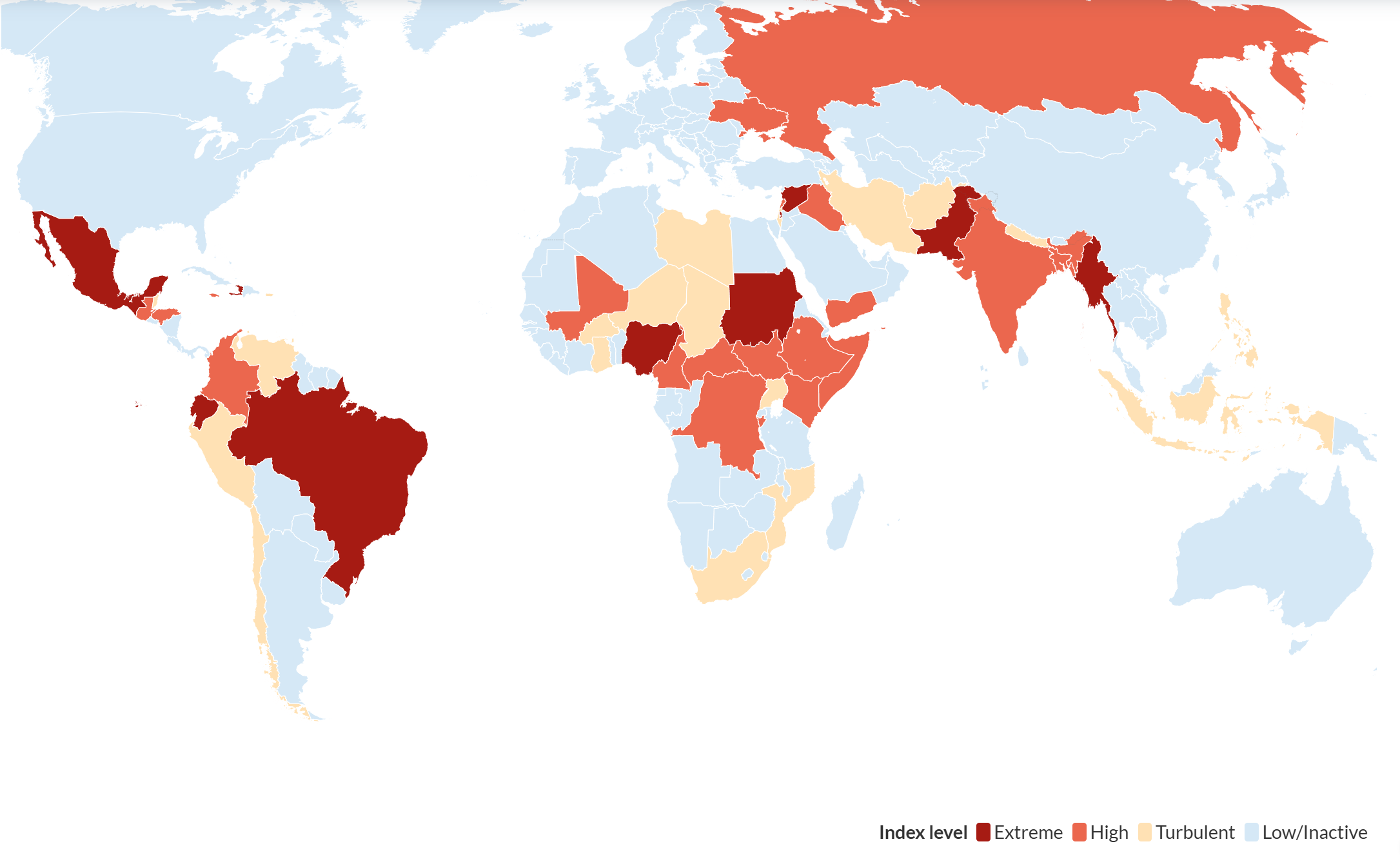
Recent well-publicised events in South America demonstrate to those who have forgotten that it is actual power – rather than one’s moral or ethical position, or some imaginary ideological world that exists among the habitues of Islington’s cafe society – that matters in the ordering of world events. Without actual power you simply don’t get a vote. People used to know this, of course, but in the serial naiveite that has infiltrated political and intellectual circles in the UK since the end of the Cold War we have persuaded ourselves that we no longer need this form of power, especially military power. All we need is something called ‘international law’ to keep us safe. Presumably this is because we have persuaded ourselves that if the world is united in its determination to live by rules supposedly outlawing war, we no longer need strong armed forces. Nor do we need anything other than soft power (‘money’) to persuade people in far flung reaches of the world to live like us. And when all these instruments of hard power are finally gone, and soft power triumphs, we can luxuriate in this new found nirvana and the world will be at peace.
Nonsense.
Rules are, of course, important. They order international behaviour, and they reflect the world’s (or part of the world’s) views on how we should behave. The establishment of the UN in 1945 was deliberately designed to bind countries to a set of behaviours that all or most found acceptable, policed by a very big (mainly U.S.) stick. This included the prohibition on intervening in the sovereignty of one’s neighbours for anything other than self-defence, in support of a treaty ally or the protection of that neighbour from horrible abuses perpetrated by a third party (which could include the rogue behaviour of its own rulers). But those rules must also reflect the reality of the world; its security considerations, its legitimate domestic security issues, genuine state on state disputes and so on. They need to reflect the reality that war is an instrument of policy, and can be legitimately used thus. But they also need to recognise that laws can be used by one side against the other - as weapons - as the UN’s position on Gaza for instance demonstrated. Just because a law exists doesn’t mean that its strictures are simple, or apolitical. Everyone has an agenda, even some (biased) lawmakers.
International law in this sense is a framework in which we can all operate, but it cannot be a law in itself, self-asserting and self-actualising as though somehow a rule can take on and express a moral position. Law is the servant of the lawmaker, not the other way around. Sometimes the application of law can in fact be immoral, again seen in the weaponisation of the UN in its response to the way Israel defended itself against Hamas in the years after October 2023.
With the law such an inadequate thing, what remains is that it is the political behaviour between states – not ‘a’ or ‘the’ law – that must count in international discourse. It’s the quality of our relationships, with friends, enemies and frenemies, that really matters. How do we influence this suite of national actors to respect our wishes and bend to our views? It is about how we exercise our power, both hard and soft. There are military ways of doing this of course, but there are many others too: diplomatic, economic, political and so on. To exercise any form of power needs the political gumption (a) to know what our national interests are and (b) to act when that national interest needs protecting.
You might think that what the USA has done in Venezuela is illegal, but that’s simply your view on a particular, contested, legal position. Rightly or wrongly the United States has determined that it is within its national interest to arrest a foreign subject - even a foreign leader - on foreign soil and extradite him to the US for a criminal trial. You might wish it were different, but that doesn’t make it so. As Patrick Porter has reminded us, the world is not a morality play. These are Big Boys rules folks, and we need to understand them if we are going to be able to (a) understand what the USA is doing and why and (b) respond maturely within the diplomatic and military relationships that exist between both countries.
None of this suggests for one moment whether or not I think that Washington has got it right, or wrong. I wouldn’t presume to understand all the issues. I can see some things that make complete sense, and others that don’t. These are immaterial to my argument, which is that if we don’t understand how the world works, or the role of law within this dynamic paradigm, we simply inhabit a fantasy world in which some political moralists feel entitled to tell us what international action is acceptable, and what is not.
So, let’s stop wringing our hands about events we dislike. Our national leaders need to own the reality of the big world out there. As a country we need to behave as though we truly believed that we were master of our destiny, and act in accordance with a commitment to Britain’s national interest.
That I need to say this to the country of Palmerston and Disraeli is somewhat disheartening but as I’m a realist, there are somethings I’m simply forced to accept, even though I don’t like them.
There has been too much hand-wringing of late in Westminster. This is not the world some people thought they lived in. More fool them. We must do better. Understanding how the world actually works is the place to start. We need to be a bit more realistic.
As some apocryphal law professor supposedly said:
"International law doesn't exist, but it's fun to talk about it."
Yes, very much concur.
We have to ask ourselves what happens:
> when we discover that the UN is fundamentally compromised and corrupt and is no longer fit for purpose?
> when we realise that Britain’s leaders willfully place international law above British sovereignty and Britain’s real interests, because they signed the country up to making supra-national governance
> when it becomes obvious that unelected, non-sovereign individuals and corporations have assumed powers that they are not entitled to - and that they mean to do grievous harm to individual freedoms and property rights?
Lastly…….war schmaw, there has not been an unequivocally just war since the Falklands in 1982.
All wars - and actions - since have been initiated for national interests not sovereign territory…….often on spurious, manufactured grounds.
Gulf, Bosnia, Somalia, Iraq, Afghanistan, Syria, Ukraine you name it - have all been about ‘interests’ hardly any of which have pertained to the citizens of those countries.
The nature of war has changed as well. Kinetic wars in places such as these are ‘tolerable’ - whereas other wars are framed in different dynamics: economic, cyber, societal destabilization and political corruption.
The world has been fracturing into large pieces - like a satsuma orange.
Trump decided that US interests were not served by continued tolerance of Venezuela being colonized by US’s enemies and used as a base for hostile activity.
We should expect more of these nebulous proxy wars US vs China vs Russia vs globalists…….common people will not be party to the angles involved.
The best we can hope for is the preservation of individual nations and the freedoms of individuals.
Britain and EU stand on the cusp of dissolution…….fortunately though, they have no hard power…..and are led by weak, corrupt and depraved fools.
They cannot win.