
Clement Attlee: A Fine Role Model
Advice for our new Prime Minister, by Christopher Jary

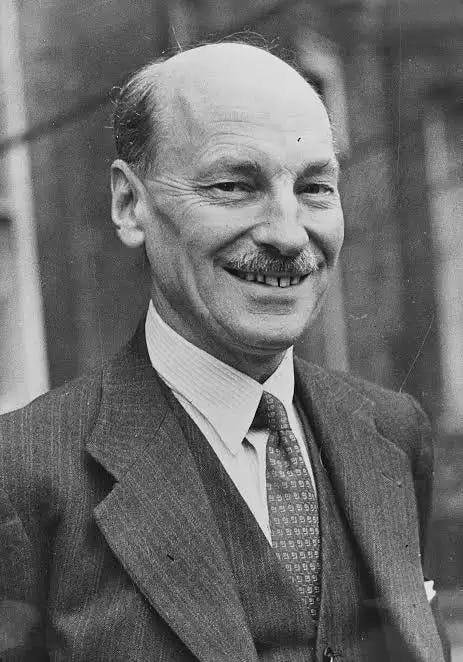
In writing our book on Korea two years back General Lord Dannatt and I were much taken by the principled leadership of Clement Attlee, the man who led the Labour Party to victory in the 1945 General Election, and who insisted that Bill Slim would be his C.I.G.S. in late 1948. Attlee saw instantly, at the moment of the North Korean invasion of South Korea in June 1950, that in refusing to counter naked aggression against a neighbour a la Munich in 1938, and thereby upholding the principle that sovereignty was inviolable, an aggressor would be allowed to flourish. He would not allow that under his watch. As we wrote, being accused of being a ‘Tory appeaser’ would have been, for him, a slur too far:
Attlee saw the issue in the same way as Truman. The governing Labour Party on the whole was united in the view that this was a war of naked aggression and that a collective response was required by the world to oppose a blatant act of lawlessness, made worse by the fact that it was again the communists that were causing the trouble. Giving in to the aggression was what the Tories had done with Hitler in 1938. Britain and the democracies needed to stand up to this sort of militarism and reject appeasement. It never worked with dictators. Indeed, it tended to encourage them. Attlee believed that if the U.N. was to have any more credibility than the League of Nations it needed to act decisively against aggression of this kind. Likewise, the U.K. needed to be in the vanguard of the response. Britain had discredited itself when standing up to challenges to national sovereignty in the 1930s; it had learned its lesson. If Chamberlain, the Tory-appeaser was the villain of this story, Attlee would be the protector of international law. But remaining in close step with its wartime ally, despite significant challenges to amity (such as the McMahon Act, which at a stroke removed the U.K. from involvement in the U.S. atomic programme, something that Britain had helped with immeasurably by handing over its atomic research secrets to the Manhattan Project), was important to Atlee. The Conservative Party, in opposition under Winston Churchill, agreed with Attlee’s instinctive reaction to news of the North Korean attack, and supported the government in what Churchill described as ‘his inescapable duty.’
Likewise, Attlee valued the U.K.’s relationship with its friends. The willingness of the U.K. to send troops to Korea in support of its membership of the U.N. and as a token of its commitment to an ongoing friendship with its great wartime partner – the U.S.A. – was never in doubt. Britain and the U.S.A. had a considerable recent history of partnership in adversity, and the depth and intensity of this relationship could not be easily dismissed. As Downing Street considered its options, the Cabinet Secretary, Norman Brook, observed that Korea was a rather distant obligation: the Prime Minister is said to have replied: “Distant yes, but nonetheless an obligation.”
Attlee’s perspective on the cost of national defence was one that has much resonance today. In the period after 1935 Attlee had led the camp in the Labour Party arguing the case for peace between nations based on the threat of collective military action to deter and resist aggression. His view was that national armaments, such as those held by the U.K. for instance, should be purposed not for selfish national ends but to support the collective enforcement of international law and the achievement thereby of global peace. The organisation existing at the time to achieve this purpose and to police international behaviour was the League of Nations. It had failed because there had been no willingness by its members to allow collective action to work. Now, in the post-war world, its successor needed all members to pull together and commit to collective military action when peace was threatened. The answer was not, Attlee believed, the sort of Tory appeasement that had encouraged Hitler to further and greater acts of egregious violence against the peace of Europe during the 1930s. Peace needed to be protected against villains wheresoever they might appear. This included Korea. Today, it includes Iran, North Korea and Russia.
My friend Christopher Jary, a fine historian who has just written an excellent account of the 2nd Dorsets at Kohima to add to his previous pile of excellent books, has just sent me an article he has written for the Civil Service website. With his permission, I attach it here. It is advice for our new Prime Minister.
And so we have a new Prime Minister, who tells us he is looking to Neil Kinnock as his inspiration. He could do much worse. I have first-hand experience of Lord Kinnock’s kindliness and humanity, and we must never forget that in the 1980s he bravely led the first miles along the long, bumpy road to making a dysfunctional Labour Party electable once again. When David Cameron became Prime Minister he told us his inspiration would be Harold Macmillan. His choice too had its merits. But in my view neither Kinnock nor Macmillan is the best role model.
My model for an effective Prime Minister stands in the Members’ Lobby outside the Chamber of the House of Commons. Characteristically, his statue is the least impressive of the four 20th Century Prime Ministers who stand vigil there. At one end Churchill towers over Lloyd George. Together – in the great reforming Liberal Government before the First World War – both strove (in Churchill’s words) to introduce health insurance and old age pensions… to fasten a lid over the abyss into which vast numbers used to fall, generation after generation, uncared-for and indeed unnoticed. Having launched these social reforms with Churchill as his lieutenant, Lloyd George then led his country to victory through a world war of unprecedented horror. Churchill did the same a generation later.
At the other end of the lobby my man’s statue is similarly upstaged by the most recent Prime Minister represented here. Margaret Thatcher forced the country, after a decade or more in financial cloud cuckoo land, to confront economic reality, and she simultaneously ensured that Argentina’s murderous, fascist regime was pitched summarily out of the Falkland Islands.
Standing beside this loquacious, combative trio, the reticent, unaggressive fourth figure may at first seem slightly overwhelmed. Not a bit of it. A man of few words, he was yet a man of action. Quietly spoken, his commitment to social justice was every bit as passionate as Lloyd George’s. From a deeply conventional upper-middle-class boyhood (Haileybury and Oxford) and after gallant service (of which he remained deeply proud) as an infantry officer in the First World War, Clement Attlee emerged as not only the most radical Prime Minister we have ever had, but also as one of the most effective. In the years 1945-51 his Government’s legislative programme was immense. Nothing on this scale has been attempted since. How did he achieve it? That is the question any modern prime minister needs to ask because the answer holds the key to something that could be done now that would transform the whole business of government.
There’s an old joke (enjoyed – you’ll see why in a minute – principally by elderly clergymen) in which a political firebrand pronounces that Christianity has failed and an elderly clergyman replies with a benevolent smile. “But it’s never been tried.” The same joke might be applied to Cabinet government. We claim to have it. We have a Cabinet room. We have a Cabinet table. We have Cabinet ministers and Cabinet papers. We even have a Cabinet Office. But few would claim that we have practised Cabinet government for decades. And the glowing exception to this broad claim is Major Clement Attlee’s Government, which simply could not have achieved so many of its wildly ambitious aims without a Prime Minister skilled in pretty much every aspect of managing his Cabinet. This little man, who looked like a bank manager, conducted business with ruthless despatch.
So my advice to our new Prime Minister – who seems enthusiastically full of ideas for change – would be: Don’t try and do it all yourself. Appoint your Ministers, agree in Cabinet what needs to be done and then let them do it. If they fail, sack them. If they’re doing well, pat them on the back and leave them alone. Apart from any wider consideration, this approach will make your job easier and give you time to think. And you’ll need it.
Funnily enough, this isn’t the first piece of advice I’ve given Andy Burnham. In 2005, when he first joined Tony Blair’s Government, he was one of about eight newly appointed junior ministers who each took up a suggestion from the Prime Minister’s Delivery Unit[1] that they might like to spend a morning with me discussing how ministers can get the best from their civil servants. At that time I was on the staff of the National School of Government[2], teaching civil servants how to serve ministers; this enabled me to see the other side of the coin. I remember thinking that my grandmother would have described him as “a nice young man”. He had just been given one of the worst jobs in government in a major department of state and I remember high among his concerns was how to balance the demands of being a minister in London with his responsibilities to his wife and young children in Liverpool. I was horrified to hear that some senior officials in his department were telling their quietly spoken young junior minister that they advised only the Secretary of State! I told him that was nonsense and had to be stopped and I hope he acted on my suggestion. I hope even more that his more recent on-the-ground experience in Manchester will have given him the solid sense of the practical reality of Government policy that Lloyd George acquired among the mining villages of Wales and Attlee among the slums of Limehouse. Burnham’s chairing role in Manchester may also prove a good preparation for getting the most from his Cabinet.
Among Andy Burnham’s first appointments to his Cabinet was the new Chancellor of the Exchequer, John Healey, who by chance was another of the eight ministers who spent a morning with me back in 2005. I liked him at once and admired the seriousness with which he seemed to be approaching his work as a minister. I had already heard from some of his civil servants that he corrected their English in drafts they sent him – and I was with him all the way on this. When most recently he resigned with his entire ministerial team from the Ministry of Defence, I applauded: not just because the issue justified resignation, but because of what it reveals about the relationships within the ministerial team John Healey led. They worked together and resigned together. It promises well now he is at the helm of the Treasury, where his new team has the chance to increase and target spending to ensure that our armed forces can respond confidently and effectively to those who threaten the peace.
Attlee’s innate reticence extended to his relationship with the press. In 1951 a reporter asked him if, having just called a general election, he had anything he’d like to say. “No”, he replied. For three decades the received wisdom in government has been that the media crocodile must be constantly fed with good stories. In a climate in which the press is now tutting with disapproval at the seven prime ministers we have had since 2016 when they played such an irresponsibly destructive part in bringing some of them down, such a laconic, Attlee-esque approach might be refreshing.
There’s always hope at this stage in a new government that good things may happen. Too often these chances are missed but our new Prime Minister would stand a better chance of bucking that trend by adopting Clement Attlee as his role model. If he does, he’ll find a lot of his jobs will become much more manageable.
[1] A regrettably jargony title for a team that did some good work.
[2] Once the Civil Service College at Sunningdale.
One of the key changes the Attlee Government brought in was advanced Welfare policies, and of course, the NHS.
Great ideas at the time - and still are to a certain extent.
Unfortunately, these policies have turned into beasts that cannot be touched or drastically reduced by ANY Government. The mere thought or statement that they need reducing brings words of hate from the population.
It can be near 100% guaranteed that any Government that touches the two of them will be out the door at the next election - if whatever PM survives the term after having done so.
If anything, these two (at the time) wonderful ideas have really become the downfall of the UK. Money has to be allocated here first before anywhere else. Other areas - such as defence and infrastructure - get the pickings.
Currently, the only way to get more money is to tax everybody - all well and good if everyone contributed, but they don't. You can't keep on taxing the population.
I hope Burnham takes the risk and strips the two of them of money and shares the rest around other areas in desperate need. Fingers crossed our new Defence Minister and Chancellor get what they want.
One of the major flaws of the 24/7 news machine is that news doesn’t actually happen that way and therefore in order to fill airtime they presented “gladiatorial contests” pitting eager victims against each other as they fantasized about the might have beens and still could bes of some latest event and may the loudest and most outlandish speculator win. You simply can’t control the beast or even keep up with it, you can only control your response. I do think Atlee is generally under appreciated.