
Battle is Joined
The truth about the brilliant defence of GPT Ridge by Captain Douglas Frew MC, 3/3rd Queen Alexandra's Own Gurkha Rifles, at the start of the siege of Kohima, 3-6 April 1944.

In a widely cited account of the war in the Far East published in 2004, the two co-authors (academics, not soldiers) used War Diaries selectively and mischievously to mischaracterize the nature of the fighting in the early days of the battle of Kohima. When I first read this over twenty-years ago, knowing something of the battle, I was irritated at the mischaracterization it represented and discussed it with surviving veterans. I even posted an unfavourable review somewhere, though this was lost in the noise of the adulation which surrounded publication of this ‘ground breaking’ book. The veteran’s view was that the slur was a deliberate calumny designed to demonstrate the essential, systemic weakness of colonialism, through the failure of its armies in battle, and I recall some angry correspondence doing the rounds in the veteran community to which I had become close. This view may or may not have been true. The author’s certainly enjoyed making fun of British military expertise, an approach I always found strange given the ultimate success of the imperial armies against the Japanese in 1944 and 1945. In any case, their selective use of War Diaries demonstrated a profound level of ignorance about how the British Army (and Indian Army) records its story of battle. War Diaries need to be interpreted carefully, as they are the daily expressions of tired and busy unit staff officers (usually the adjutant) about what that unit has been through that day. They are often wrong. They rarely demonstrate any real understanding of what is going on in the wider battle, sometimes even the trenches of a neighbouring unit, although of course they are essential accounts of the view of the officers commanding that unit, on that particular day. In the 2004 account, the story is that the ‘British’ incompetently prepared for the battle, with untrained troops fleeing from the arriving Japanese, consternation and chaos abounding, the result of British ineptitude and mismanagement. This mischaracterization was then copied in a best selling account of the battle of Kohima published in 2010. I’ve just seen it also repeated in Sam Dalrymple’s otherwise very readable book, Shattered Lands, who clearly uses the 2004 source uncritically. Its an example of how one piece of unfairly or erroneously interpreted evidence can skew the story of an entire event, in this case a battle. More than that, it can be used to prop up evidence for other perspectives entirely unrelated to the event in question.
Suffice it to say the 2004 account of ineptitude is wildly misleading. The story that follows has been written to set the story straight. It provides the account of Captain Henry Douglas Frew MC (known as ‘Douglas’) in his efforts to defend the south eastern approaches to Kohima in first 36-hours of the battle on the southern flank of Kohima.
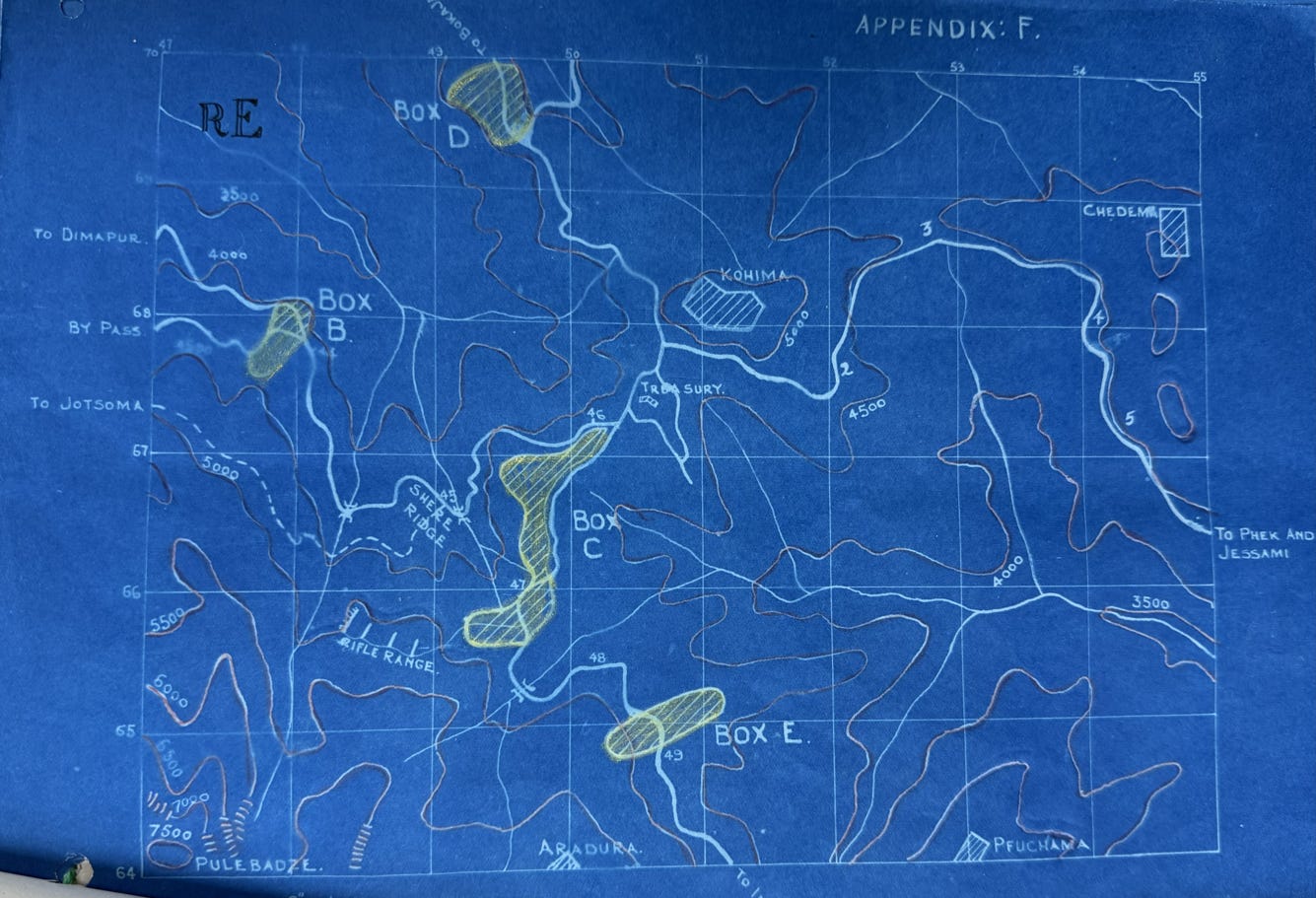
On Saturday 1st April 1944,the Garrison Commander’s preparations to receive the Japanese at Kohima were well underway. After consolidating the previously planned four defensive boxes into a single one on Kohima Ridge (see map above), Colonel Hugh Richards now began scouring the area for troops who could fight. No 57 Reinforcement Camp, based in tented barracks in the hills northwest of Kohima Village, existed to prepare troops for joining (or rejoining) their battalions on the front line, sharpening their individual fighting skills before going to or returning to, their units. Troops returning from leave, hospital or their recruit depots across India would spend time at one of a number of these camps before they were sent on to their battalions. Every day was filled with weapon training, small unit tactics, fitness, musketry, camouflage, first aid, patrolling, and the duties required of soldiers in the various phases of war: defence, advance to contact, contact and withdrawal.
For this reason, and to Kohima’s great benefit, the several hundred soldiers – Indian, Gurkha and British – in No 57 Reinforcement Camp were well trained and, on the whole, capable. One of the Company Commanders was Captain Douglas Frew of the 3rd Battalion, 3rd Queen Alexandra’s Own Gurkha Rifles. Richards called for him on the late morning of 1st April with instructions to gather a company’s worth of trained men to guard the eastern approaches of Kohima just beyond Milestone 48 on the road to Imphal. He was instructed to place block on the road at Workshop Ridge, where the IEME had a vehicle repair workshop (previously designated as Box E), and to prevent Japanese infiltration past this position towards the main box between GPT Ridge, Jail Hill and DIS, at the top end of Kohima Ridge, which lay beyond. Frew looked around him. He could pull together his seventy young Gurkhas, men who had recently completed recruit training, and ten of his own Gurkha NCO instructors from the camp. Led by a Gurkha Jemadar, Lalbahadur Thapa, these men were exceptional soldiers. In addition, at the Convalescent Camp on Treasury Ridge were men preparing to return to their units after recovering from wounds or illness. This included a contingent of eleven vastly experienced men of the 17th Indian Division, men who had fought all the way from the start of the war in Burma’s Tenasserim in January 1942. They had been at the camp waiting to return to their units at Tiddim, far to the south of Imphal. As the Japanese had cut the road on 29th April, this was no longer possible. This would give him a company of just over ninety men, some of them battle hardened but most having recently completed their prescribed period of eleven months infantry training, a period of time which included a lengthy nine months of basic training followed by two months of jungle warfare training. The coming battle would demonstrate whether the new training regime introduced to the Indian Army the previous year had achieved its purpose of preparing recruits for the task of fighting the hardened warriors of the Imperial Japanese Army.
Frew and his NCOs immediately hurried around collecting as many weapons and as much ammunition as they could find, as well as a week’s rations and stores. In three hours they collected twenty-four Bren guns, nine Thompson sub machineguns, and seven two-inch mortars. Due to the pre-war proscription on barbed wire in the Naga Hills there was only a limited amount in the stores depot, but they took that, too, for the road block.
Later that day a small convoy of lorries took the now heavily laden company across the Kohima area, down and around the many bends past the Kohima Village on the vast hill that dominates the north of the position (known as Naga Hill), past the turn off to Jessami and down to the saddle formed by Treasury Hill with its deep valleys on either side. On the eastern side of the saddle lay the Convalescent Depot and, in the same place it occupies today, the Assam Rifles Barracks. The lorries then drove them south, up the hill to the right of which, covered in cannas and rhododendron bushes lay Charles Pawsey’s Deputy Commissioner’s Bungalow, above which lay the tennis court and officer’s club, roughly 400-feet above the road. Little did Frew think that this tiny patch of ground would be the epicentre of the dramatic struggle for the Kohima position in the weeks that lay ahead. This was Garrison Hill, occasionally also referred to by an earlier name: Summer House Hill. As the heavily laden lorries ground their way up the hill in low gear they passed areas of ground who’s names would come to be indelibly associated with the coming battle: Kuki Picquet, Field Supply Depot (FSD), and Daily Issue Store (DIS) Hill, the last being at a height of 4,700 feet. Here, near Milestone 47, the road curved right between DIS Hill and Jail Hill and then left between Jail Hill and Pimple Hill on the northern end of General Purposes Transport (GPT) Ridge before debouching south again where, deeply cut into the hillside, it twisted along the eastern flank of GPT Ridge for about 500 yards. It then swung due east overlooked by the heights of Aradura Spur on its right while, on its left, the ground dropped precipitously into the valley. Just before Milestone 48 the road took a sharp turn to the south then bore south-west and, after a few hundred yards, were the abandoned IEME workshops, forward of which the roadblock was to be established.
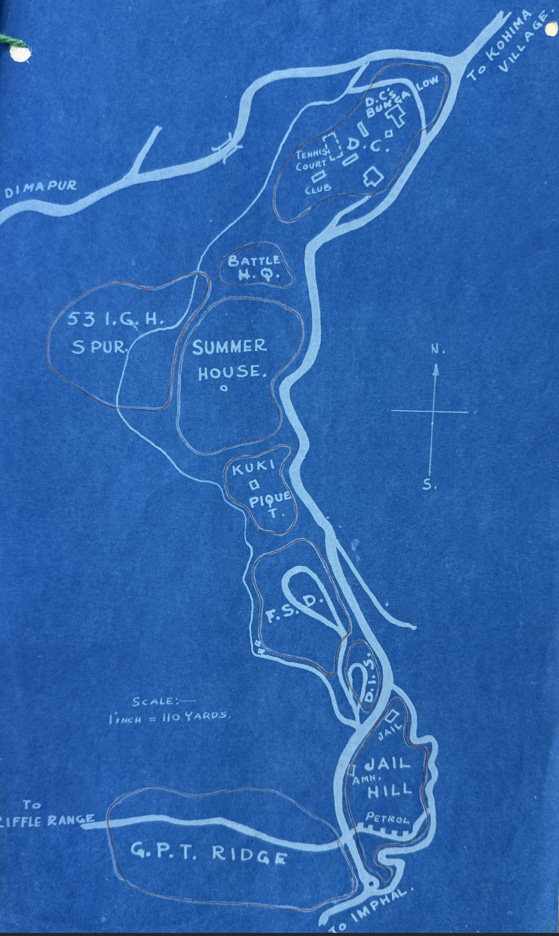
Frew looked around him. As he faced towards the direction from which the Japanese would arrive an extremely steep spur rising 1,000 feet to Aradura lay to his right. On his left the hill dropped away precipitously into the valley. It had spectacular views. To the south the road wound, climbing all the time, towards the hospital complex at Mao Songsang eighteen miles away. To the north, at distances ranging from a mile to a mile and a half, they had a good view of Kohima Village, Treasury Ridge, the Convalescent Depot, the Assam Rifles Barracks and the road junction known as the Traffic Control Point (TCP) just below the Deputy Commissioner’s Bungalow as the road to Dimapur snaked back on itself and out of sight heading down the other side of the Kohima position.
Numerous trenches had been dug around the built-up area. Not only were these badly sited but the soil had been tossed out on the downward slope making them stand out like sore thumbs against the green of the surrounding vegetation. Additionally, the trenches were too wide and about eight feet deep so that when some of the Gurkhas jumped into one it not only disappeared from view but they could only, with difficulty, climb out again. Frew decided to ignore them, and dig his own trenches where he wanted them. These previously dug ones – well meaning but useless – would be left to act as decoys.
Frew and Jemadar Lalbahadur conferred. They agreed that the position could be held successfully provided they retained control of the high ground leading up to Aradura Spur, which directly overlooked the position. The decision therefore was to split the force into three platoons. One would block the road where it met the extreme southern perimeter of Workshop Ridge. The second would be placed above the road on the right some 100 yards forward of the block, while the third would be placed immediately above the block approximately 200 yards up the hill and 300 feet higher. The first platoon would depend on the other two for its defence while it concentrated on defending the roadblock. At the time there was only one gun in Kohima, a twenty-five pounder used for training purposes, so they could not expect any artillery support. They were out of three-inch mortar range from the positions on Jail Hill and GPT Ridge behind them, so they would have to depend on their own two-inch mortars: four with the third platoon up the hillside and three with the second platoon forward and above the road.
The men quickly dug their new positions, working hard into the night. There was as yet no sign of Japanese, but that night, hunkered down in their slit trenches with no lights and a strict fire discipline enforced, they were surprised to hear, on the northern side of the valley, in the region of Kohima Village and the area of the Convalescent Depot, shots. Before long it sounded as if a full blown battle was underway on the other side of the valley, with machine-gun fire, Very lights and flares. The battle, in which no enemy were involved, expended vast quantities of ammunition and carried on until dawn.
All was silent on the road block at Workshop Ridge, until a shot was fired at 4 a.m. Two RIASC drivers, survivors of an ambushed jeep convoy beyond Mao Songsang, had stumbled into the road block in the dark, had been startled when challenged and foolishly ran into a ditch to hide before an alert sentry fired a warning shot. During the day that followed the men completed the positions, building strong overhead cover and camouflaging all the trenches. During 2nd April Frew and his men saw Naga refugees moving through the valley towards Kohima, a sure sign that the Japanese were moving closer. But Frew knew little more than he had been first briefed: that the Japanese had closed the road to Imphal further east at Maram, that the 1st Assams were undergoing trial by battle at Jessami and Kharasom, and that it was thought that the enemy force was 400 strong with a similar number following up, although no concrete evidence supported this. Nor too was anything known of Japanese plans. Was Kohima the objective? Was it merely the Kohima to Imphal road or would the Japanese bypass Kohima to fall on the virtually unprotected railhead and stores depots at Dimapur? It was this possibility that Frew knew had led to the 161st Indian Brigade of the 5th Indian Division, recently flown in from Arakan, comprising 4th Battalion Royal West Kents, 1/1st Punjabs and 4/7th Rajputs, which had been originally earmarked for the defence of Kohima, being allocated instead to Nichuguard a few miles north of Dimapur. This meant that Colonel Richards was left with the few troops he already had: the 1st Assams fighting for the lives eighty miles to the east; the willing and capable but lightly armed 3rd Assam Rifles (a paramilitary police battalion) at Kohima; the Shere Regiment of the Nepalese Army, gifted to India for anything other than combat purposes; two companies of the Burma Regiment [1]; two composite companies of Indian Infantry and one each of British and Gurkhas from the Reinforcement Camp and Convalescent Depot, plus some detachments of ‘V’ Force, an intelligence unit of irregulars created in 1942 to watch the long Indo-Burmese frontier. All up, these numbered perhaps 1,000 men who had been trained to fire a rifle. Kohima was a way station on the road between Imphal and Dimapur, full of depots, stores and repair workshops. This mean that there were perhaps an equal number of essentially non-combatant troops – Pioneer Corps, RIASC, Medical Corps, Signals and numerous clerical and administrative staff – who, if they remained in Kohima during a siege, would be an embarrassment to the defenders.
At about 1 p.m. on 2nd April 1944 Douglas Frew was called back to a meeting with Colonel Richards at the roadside between GPT Ridge and Jail Hill. Richards told Frew that because he didn’t have the manpower to defend everywhere equally, he had decided to withdraw all his troops to the Kohima Box, with the aim of denying the whole stretch of the road around the position to the Japanese. The idea was that the small garrison that he had would hold Jail Hill and GPT Ridge down to the Traffic Control Point and across to the Indian General Hospital on the western edge of the ridge. If the Japanese did arrive in force, his plan was to hold the ridge on the largest perimeter possible, sending the ‘useless mouths’ down the road to Dimapur and holding reserves in the centre of the position on Garrison Hill. Frew was therefore to withdraw his little company into the perimeter where it would be responsible for defending GPT Ridge. He would be reinforced by two, understrength, composite companies of Indian infantry, one commanded by a Punjabi havildar-major and the other by a Sikh havildar major, a Vickers Machine-Gun section of two guns manned by a sergeant, a corporal and five British other ranks from 57 Reinforcement Camp and, to his delight, a composite platoon of Gurkhas from the 17th Indian Division, the ‘Black Cats’, under the command of a Jemadar, Ranbahadur Gurung. The 22-year old Captain Frew now boasted a force equivalent to a weak battalion: his own Gurkha company, plus two Indian companies (albeit weak), and an additional Gurkha platoon together with now thirteen two-inch and two three-inch mortars and, now, a Vickers medium machine gun crew. In addition to this force on GPT Ridge, a company of the Nepalese Shere Regiment was positioned on the road to the front and stretching up the heavily forested slopes of Mt Pulebadze which towered above the position on the southern (right) hand side.
By 5 p.m. the whole roadblock force had moved back to GPT Ridge and began digging in on the left half of the Ridge just south-east of Pimple Hill, on the southern (higher) side of the hill. Frew sited his fifteen mortar tubes to the east (i.e. the rear) of Pimple. A careful fire plan was then worked out, identifying all the areas where an assaulting force was likely to form up, and listing these as targets for the mortars and machine guns. On the left hand perimeter was a sheer drop of thirty to forty feet to the main Imphal road. This gave excellent control of the road without fear of being over-run by the enemy. Beyond the road the ground fell away sharply into the valley. To the left front Frew had a perfect short-range view of the road as it travelled due east just before it turned hard right round Aradura Spur to Milestone 48. The two Vickers machine-guns were sited so that they dominated the main road to the south and would be able to discourage enemy mortars or artillery from taking positions on the forward slopes of Aradura Spur. From the top of Pimple Hill there was a forward field of fire in excess of 150 yards, though the remainder of Frew’s position was on the reverse slope at the base of GPT Ridge. The men dug ten five-to six-man trenches, giving mutual fire support, with strong overhead cover. All trenches on the left and middle of the left flank had at least one Bren-gun while those on the right overlooking the ground in front of the forward Indian positions had two with the ability of firing to the front or the right. Jemadar Ranbahadur was placed in command of the two platoons of Gurkhas who would occupy the new bunkers on the left flank and Jemadar Lalbahadur in command of the remaining two platoons of Gurkhas. The two platoons of Indian infantry were in the charge of the Sikh havildar-major. Jemadar Lalbahadur’s tasks were to provide the counter-attack force, to dominate the road between our position and Jail Hill and to liaise with the Burmese on Jail Hill.
That night – 2nd April 1944 – was dark and cold and there was apprehension in the air enhanced by the swelling sounds of small-arms fire, which continued throughout the night. Frew didn’t know it, but that day Lieutenant Gurung and fifty-six men from Kharasom had arrived in Kohima, together with forty men of 1st Assam Regiment from Jessami. The remainder of the survivors from Jessami would arrive the following afternoon, 39-hours after the start of their withdrawal, and would find themselves placed on Jail Hill to Frew’s left.
The morning of 3rd April dawned bright after a cold night, the men warming themselves with exercise in extending the position on the left, improving the trenches already dug with more sandbagging and overhead protection, digging more mortar pits and bringing up further supplies of ammunition, food, water, equipment and stores. Frew observed that there ‘was a surfeit of everything except wire of which there was none – an inexplicable, incredible and inexcusable omission would cost the Garrison many lives. Apparently Colonel Richards’ many appeals for wire from Dimapur, where there were massive stocks, fell on the deaf ears of incompetent staff.’ Frew wandered across to Jail Hill to confer with the men commanding the two companies of the Burma Regiment occupying the hill, and agreed a defensive fire plan. Visiting Richards’ HQ in a bunker on Garrison Hill that day, the young Frew observed to himself that the fighting men were widely dispersed, and non-combatants were numerous, many wandering about Kohima Ridge, seemingly unsupervised. The infantry on DIS consisted of a composite company of British from 57th Reinforcement Camp and on FSD Ridge were two platoons of 27/5th Mahrattas, also sourced from the Reinforcement Camp. V Force detachments withdrawn from the frontier areas were on Garrison Hill and men of the Shere Regiment defended Kuki Picquet. Richards told him that in fact the Shere Regiment had a screen out to the west stretching as far south as the upper slopes of GPT Ridge but there simply weren’t enough trained soldiers to hold the position for a prolonged period, especially against a numerically superior enemy. But he had no reason to believe that the Japanese force soon to arrive in front of his position was anything other than equal to his own numbers.
During the afternoon the first men from Jessami arrived on Jail Hill. ‘They were hot, tired and footsore’ observed Frew, ‘but in pretty good order considering what they had been through.’ One platoon, under command of Lieutenant Pieter Steyn, came to GPT Ridge temporarily as they could not immediately be accommodated in suitable positions on Jail Hill. That day Frew sent out fighting patrols south of his position (i.e. in the foothills of Mt Pulebadze) but no enemy were sited. Then, just as it was getting dark, the British sergeant commanding the Vickers gun on his left flank and whose position was thirty or forty yards from Frew’s command post called him over to report that he had seen an infantry section lower down on to the main road 500 to 600 yards at the point where it took a sharp turn to the east. The patrol of about eight to ten men was working its way towards their position, keeping close to their left and scurrying round the bends where they came into view for a few seconds. Their behaviour was most suspicious but their uniforms did not appear Japanese and, in fact, were similar to those worn by the Shere Regiment, which was the same as the British but not dyed jungle green. When they came close Frew saw that they were short and powerfully built. ‘They moved well and obviously knew what they were doing and I was pretty sure that these were our first Japanese.’ A Gurkha issued the challenge, as which the patrol raced back, jinking to the nearest cover. The shots that followed them caught at least two of the enemy, whose bodies were dragged away by their comrades.
Then at dusk, a British fighting patrol under command of Major Norman Giles arrived from DIS, sent out on reconnaissance by Colonel Richards, who had told him to report into Frew on his outward journey. Frew told him that he already had a fighting patrol out, and to be on the lookout for them. He warned Giles of the proximity of the enemy and of the Gurkha patrol and described to him its expected return route. The patrol then slipped away up the slope and into the trees. All was quiet for some time when suddenly there was a commotion about three hundred yards to the south with lots of yelling and screaming and flurries of shots. The noise ended almost as abruptly as it had started and shortly after a loose body of men passed across Frew’s front travelling north, down on to the Jeep track and on towards DIS Hill. It was clearly the British patrol returning. About an hour later an elated Havildar returned with his Gurkha patrol to Frew’s position. The patrol had first headed up the slopes of Pulebadze, where it had come across a platoon of the Shere Regiment, in an ambush position designed to catch anyone coming from the east. The havildar noted that he considered the platoon’s positions to be poor and that, although willing enough, the platoon was raw and poorly prepared for active service. Continuing east, they came across a large number of Japanese digging in on the slopes of Aradura. The patrol circled to the rear of the enemy position and set an ambush where a rough path wound through thick undergrowth some eighty yards to the east. Five Japanese - one officer and four private soldiers - were caught and silently killed with kukris as they passed through. The Gurkhas searched the bodies and recovered a map case and documents that subsequently identified the men as privates of the 58th Infantry Regiment: the officer and one soldier were from the 31st Mountain Artillery Regiment. The Havildar then related to Frew that a short sharp fight had taken place to the front of the position. The British patrol had apparently attack the Japanese with a bayonet charge.[2] The havildar waited until the tumult was over before returning to GPT ridge with news of the skirmish and to deliver the enemy documents safely.
That night a cacophony of small arms fire could be heard on the northern side of the valley from the area of Kohima Village. All was quiet on Jail and GPT Hills until at about 8 p.m. the British Vickers gun sergeant called Frew over to show him the lights of vehicles approaching from the direction of Milestone 48, where Frew’s men had been until the previous day. Frew told him to consider any vehicle as enemy. Soon, four lorries came round the corner in close convoy. They were allowed to run for about quarter of a mile before the Sergeant opened fire with his Vickers guns. The lead lorry was shot up and caught fire. As the other lorries came to a halt, the last one was also set on fire and the two Vickers guns sprayed all four from head to tail over and over again. The remaining lorries caught fire and a number of Japanese, who were slow in debussing, came out burning. Of the sixty or so in the lorries almost all were shot or burnt but a few jumped from the road down the near precipice into the valley, a scene observed by all of GPT ridge in the light of the burning vehicles.
All was quiet for just over an hour when suddenly, at about midnight, well forward of Frew’s position on GPT ridge and much higher up the slope, a firefight broke out which lasted for about five minutes. A little later a number of vague shadows ran across the Gurkhas right flank and on to the Jeep track, heading down to DIS. Some shots were fired at them but fortunately without any hits as they were members of the Shere Regiment who had been routed from their ambush position. A battle hardened fighting patrol from the 58th Infantry Regiment had completely out fought and demoralised the men, the survivors of whom had broken and run. It was hardly surprising. The Shere Regiment had not been trained as thoroughly as the men of the Indian Army, having been sent by the Kingdom of Nepal to relieve Indian Army units of the burden of guarding installations in India while they were released to fight the Japanese.
It was clear to all on Jail Hill and GPT Ridge that battle would be joined on the following day. The Japanese had arrived.
A small patrol sent out at dawn on 4th April came back with the news that the enemy had two companies of infantry well dug in some four hundred yards to the south (i.e. uphill, on the slopes of Mt Pulebadze) and a body of other troops who were digging-in quietly just in front of them. As the havildar was giving his report, a series of dull thumps were heard in the distance, and a flurry of mortar bombs landed on the position a few moments later. In the hours that followed, intermittent sniper fire began against the position, Frew believing that the mortar attack had provided cover for a handful of Japanese to climb into trees and to begin the low level harassment of the GPT positions. The sniping was the prelude to the first formal Japanese attack on GPT Ridge about two hours later, on the mid-morning of 4th April. It was broken up by Frew’s foresight. The men heard a high-pitched, almost falsetto, voice shouting in bursts followed each time by a roar of massed voices in concert – obviously a Japanese officer or NCO haranguing his troops prior to attack. Frew signalled for his two-inch mortars to open up along the front with the main concentration in a clearing in the trees from where the noise seemed to be coming. The fire was effective as the shouting soon turned to screaming and, almost immediately twenty or so enemy came sprinting over the ridge above the forward Gurkha positions yelling ‘Banzai’ at the top of their lungs. The Gurkhas held their fire was held until they were ten to fifteen yards short of the front bunkers when the men opened fire in unison and the Japanese were just blown away. Thank goodness for repeated musketry drills thought Frew. The action was over so quickly that one had to view the bodies to believe it had taken place at all. They were left where they were: it was foolhardy to attempt to recover documents and intelligence material during the hours of daylight.
The next attack, however, was a silent one. At dusk, during ‘stood-to’, the Japanese attempted to rush the forward left positions on GPT. ‘They just appeared with no prior shouting or mortar barrage’ Frew recalled. ‘They obviously realised that this flank was the key to the defence of our entire position and they put in a very determined attack.’ The massed mortars which he had positioned behind GPT fired immediately and saturated the area forward of the trenches. Likewise, the unexpected weight of the Bren gun fire from the bunkers shook the enemy. But still they came on. Frew could see that enemy soldiers were sacrificing themselves in order to blast passages through the wire to the Gurkhas front. Whatever else might be said of them, the Japanese were brave. Their friends simply ran over their dismembered bodies. By the time the attack died away, Frew found that he had lost three dead and about six wounded: the enemy hadn’t broken through, however, and probably twenty bodies lay in front of the position. From the papers recovered from the bodies that had not been dragged away (a standard Japanese practice was to take their dead with them) it was confirmed that the enemy was the 58th Infantry Regiment, ‘a tough, competent group of regular soldiers’ he observed.
The platoon of the Assam Regiment under Pieter Steyn now moved back to Jail Hill. It was now commanded Major Lowe of the Assam Regiment and Lieutenant Corlett, who had just returned from Jessami and held the battalion’s mortars, reinforcing the men of the Burma Regiment. Although confidence was high, the fact was that the Assams, even with the two weak Burma Regiment companies, had too few men properly to defend Jail Hill. Some tightening of the Box defences was inevitable, although losing Jail Hill meant that the enemy would be able to dominate DIS. Reducing the Box perimeter might be necessary, but it was nevertheless unpalatable.
As the Assam platoon departed GPT, Frew looked at his position and tried to assess the next Japanese move. He thought that the most obvious attack would now fall against the Indians on his right flank. They had, so far, been unmolested apart from the irritant of sniper fire which had killed two and wounded a number more.
As darkness fell that night Frew moved forward to speak to Jemadar Ranbahadur, the stalwart Gurkha commander of his left hand forward defences. He found him in excellent spirits as he had only taken a handful of casualties while his men had killed and wounded in the two recent actions at least fifty of the enemy. He was, however, disturbed by the breaching of the wire as it put his three forward bunkers at considerable risk, particularly at night. As a part remedy he had had, after nightfall, placed grenade-based booby-traps well in advance of these bunkers.
Frew’s estimate of enemy action was borne out by some probing attacks at 8 p.m. that night against the Indian positions on his right flank, attacks that appeared designed to identify the location of his machine guns. But with no outright attack, Frew suspected that these probes were the forerunners of a determined attack so he ordered his two-inch mortars to open a heavy barrage on the tree line into which the shadowy shapes involved in the probing attacks had disappeared. It was well after 11 p.m. when the expected heavy attack came in right across the front, but with much of it aimed at the Indians. The attack was started with great strength and some of the Japanese reached the forward Indian trenches before they were seen. On hearing the shouting the Gurkha Bren-gunners in the positions on the left opened up enfilading fire on fixed lines in front of the Indian positions. The Japanese were nevertheless able to capture the first two lines of trenches before they were stopped but as the Gurkhas could fire into these trenches the enemy was eventually forced to die or retreat. Most chose to die, as did their follow up troops who ran the gauntlet of this enfilade fire and the highly effective mortar barrage. This was the heaviest attack yet and appeared to have been made by two companies in separate waves.
It was during this attack that in addition to heavy casualties, perhaps thirty to forty of Frew’s composite Indian company had fled to the rear, leaving a large gap in the defences. On the left hand flank the Japanese attack had been wholly unsuccessful. Frew decided to bring up some of the men in the reserve platoon to plug the hole caused by the desertions and casualties as the alternative, a withdrawal, would leave the Gurkha position on the left exposed. The Gurkhas there were in nearly impregnable bunkers. As long as they were there Frew retained complete control of the ‘no man’s land’ in front of the Indian trenches. Frew had sited his defences brilliantly, enabling both sides to provide protective enfilading fire for the other. The Japanese were never able to breech these defences fully.
The Japanese, unaware of how near to success they had been in turning the position on the right, now switched their attack to the Gurkha positions from where the Bren-gun enfilade fire had torn their attack to ribbons. It failed miserably, however. Frew estimated enemy casualties had been in excess of one hundred while he had lost, including the deserters, some seventy men. He could at least, round up his deserters; the enemy could not resurrect his dead. Across his position he sensed, despite the losses on his right flank, a confidence that augured well for the future: his men had the measure of the Japanese. Tough as the enemy were, they were nevertheless easy to kill if fighting discipline was maintained.
With this pressure mounting it was now apparent that the immediate Japanese objective was Kohima itself. The 161st Brigade, having been despatched down the valley to Nichugard on 1st April, was now hurriedly loaded onto its transported and, gears grinding, slowly hauled back up to Kohima, where its leading elements began moving into the Kohima Ridge Box on the morning of 5th April.
Frew, in his bunker on GPT Ridge, was unaware of any of this. He was fighting an increasingly relentless battle on the Imphal Road from his position son GPT, positions which the Japanese by frontal assault had so far failed to break. At 2 a.m. on 5th April another heavy Japanese attack fell on his left – Gurkha – flank. Despite the mortar barrage, Bren gun fire and Tommy guns a handful of the 58th Regiment soldiers managed to reach the last line of bunkers. These were quickly despatched personally by Jemadar Ranbahadur charging into their midst wielding a kukri. With some difficulty Ranbahadur and his men had regained control of the position, although shortly afterwards, while checking his casualties and arranging for the evacuation of the wounded, Ranbahadur was shot with a pistol by a wounded Japanese pretending to be dead. He was quickly bayoneted, but the badly wounded Ranbahadur was evacuated back to Garrison Hill. His wounding was a grievous loss to Frew: he had fought bravely in the best Gurkha tradition and had led his men with distinction. Frew appointed Jemadar Lalbahadur to take command. The evaluation of the night’s attacks were that the enemy had suffered more than a hundred casualties while he had taken nearly thirty casualties, dead and wounded.
A few hours later, just before dawn on 5th April, the Japanese tried again to punch through the right flank of Frew’s position, held by his Indian composite company. They enjoyed initial success as they took the first row of trenches. Frew was able to look down on the position from his bunker: it was difficult to make out what was happening, as his Indians and the Japanese were all mixed together forward of our second row of trenches. This time, however, the enemy was firmly held and again their reinforcements were being well and truly shot up by the Bren-gun fire from the Gurkha bunkers on the left flank. An Indian bayonet charge removed the most advanced of the enemy and cleared them out of the forward trenches. But losses were mounting. In this engagement Frew lost another forty men killed and wounded. There were no replacements at hand, although the Japanese attacks died down for a while. Frew judged that facing him was a battalion of the 58th Regiment: tough, determined professionals. The only saving grace, he considered, was that they seemed short – for the moment at least – of mortar and artillery ammunition, presumably a result of the vast distances they had marched to get here from the Chindwin.
The defence’s ‘stand-to’ on the morning of 5th April took place in a heavy, cold, clammy mist. Visibility was limited and objects and people were not discernible beyond five yards. By 9 a.m. the sun had dispersed the mist and for the first time the positions on Jail Hill and GPT Ridge came under heavy but intermittent mortar fire. During the night the Japanese had clearly brought up some small calibre guns, from the sound of them infantry and anti-tank guns, both of which types had flat trajectories and high velocity, particularly the latter. Most of the guns appeared to have been sited on Workshop Ridge where Frew’s initial road block had been but a few guns had, during the night, been dug in on Aradura Spur close to where it met the main road. As soon as the latter opened fire they were engaged by Frew’s couple of three-inch mortars, two Vickers guns and the Brens of the Gurkhas on the left perimeter of the position. After trying to pick off his bunkers for ten minutes or so the Japanese withdrew, leaving their guns in position, as the weight of Frew’s fire was more than they cared to endure. Their mortars then laid down heavy counter-fire on the left-hand positions but had no effect, as the well-constructed top cover on the Gurkha’s bunkers proved impervious to their four-inch bombs.
When there was sufficient ammunition, Japanese artillery was accurate and effective. During the day Frew heard that the garrison’s single twenty-five pounder, sited just above the Deputy Commissioner’s Bungalow in the Kohima Box, had fired only one shot when Japanese counter-fire scored a near miss wounding half its crew. On firing its second shot it received a direct hit killing or wounding the balance of the crew and putting the gun out of action. Except for small arms Frew had no weapons with a range greater than our three-inch mortars so the Japanese could, with impunity, position their guns to fire at his positions over open sights.
Frew was nevertheless surprised by Japanese tactics. All the attacks on him so far were frontal. There didn’t seem to be any attempt by the Japanese to attempt to outflank them by crossing the hilly slopes of Pulebadze to the south, their right, and to fall on DIS from Frew’s rear. They probably did not realise, he thought, just how weakly the DIS was held. Equally, the enemy did not coordinate their mortars with their infantry attacks. Was it simply because of a lack of ammunition? Yet the Japanese did fire their mortars and artillery regularly, but not in conjunction with their infantry assaults. Frew, who despite his age, was already an experienced soldier, thought this a serious weakness in the Japanese approach to battle.
The frontal assaults continued that day. All were pressed home in spite of heavy casualties to the attackers. Time and again Frew’s brilliantly sited Bren guns had devastating results. But the mathematics of attrition were brutal. Frew’s Indian company now numbered about fifty. He had about forty Gurkhas in reserve, with some thirty of these available for counter-attack purposes. Their commander, a veteran havildar, switched his troops from the centre to behind the Indian troops on the right flank as he was sure the Gurkhas on the left would hold or, at worst, would keep the enemy at bay long enough for his men to move round the back of Pimple Hill and come up in support.
During 5th April Frew’s men could hear the defenders on Jail Hill being pounded hard. Snipers remained the greatest irritant during lulls between attacks, as well as the occasional mortar round.
In the early afternoon a message arrived by runner from Colonel Richards to say that the 161st Indian Brigade was on its way from Nichuguard. Did he think he could continue to hold, and for how long? The positions around Kohima Village on Naga Hill on the northern side of the Kohima feature had been overrun, Richards advised, and the enemy were in the Treasury area down in the saddle.
Late in the afternoon the Japanese opened up with by far the heaviest barrage to date with round after round whistling over Jail Hill to fall into the Kohima Box just beyond. Frew guessed the vanguard of 161st Indian Brigade had arrived and were being given a warm reception. Fortunately dusk was not far away and darkness gave them much-needed cover from view. With darkness came another heavy, brutal Japanese attack on GPT. Frew had by now lost count of how many assaults had fallen against his position. Successive waves struck at the Indians on the right of the position, the Bren guns of the Gurkhas again enfilading the attackers and causing considerable casualties. The Indian defenders remained resolute and remained in their trenches, allowing the Gurkha reserve, in about platoon strength, to counterattack and stop the enemy dead. The men of the reserve remained on the position to take the place of those wounded. The situation left Frew musing about the remarkable attacking stamina of the Imperial Japanese Army, though his casualties must have been frightful; certainly it would be several hundred since fighting had begun two days before. But Frew was himself losing men. He had by now perhaps about forty Indians on the right; Lalbahadur had about thirty forward on the left flank and ten guarding the road as it passed between him and Jail Hill; and the mortar havildar had about twenty-four of mixed Indians and Gurkhas. If he lost any more ground on the right flank he would have no option but to withdraw the Gurkhas from the left flank to take up positions on the right, on Pimple Hill, but he was very reluctant to give up almost impregnable bunkers which had been instrumental in his little force killing so many enemy at such light cost to themselves.
The “no man’s land” in front of the Indian trenches and between the trenches themselves was like a charnel house with bodies everywhere, mostly Japanese. The light of the flares made the scene even more macabre than in daylight. The enfilade Bren-gun fire had again decimated the enemy and destroyed the cohesion of their attacks before they reached Frew’s forward trenches. Meanwhile, Jail Hill continued under heavy attack and the Assam Regiment’s mortars, which were working overtime from the north-west slopes of the Hill, seemed to be under considerable mortar and artillery counter-fire from the direction of Naga Village and Treasury. Behind them DIS Hill was also getting a pasting as, to a lesser degree, was the remainder of Kohima Ridge. It was at this time that a runner arrived with a message from Colonel Richards to say that only one of the 161st Brigade battalions – the 4th Battalion Royal West Kents – had been able to join the garrison: there seemed little likelihood that the other two battalions would make it. Accordingly Richard’s would have to shorten the perimeter. This would entail Frew’s withdrawal from GPT Ridge and the Assam and the Burma Regiments from Jail Hill. Frew was instructed to thin out starting at 4 a.m. the following morning, 6th April. He was to complete the evacuation by 8 a.m. to correspond with the evacuation from Jail Hill. He was to bring back all his weapons and to destroy as much ammunition as we could. This wasn’t a very easy task, as it was mostly boxes of 0.303-inch dispersed in trenches throughout the position. Destruction was to be delayed to 7.45 a.m. so that the Japanese would have the minimum forewarning of British intentions.
Not long after the runner left another Japanese attack fell on to the Gurkha positions and was repelled by heavy machine-gun fire and a barrage from the two-inch mortars. A second wave came in and was broken up with relative ease. These attacks were neither so heavy nor so determined as previous attacks and gave the impression that the enemy no longer had their hearts in it. Around 1 a.m. the following morning, in swirling mists that made the night seem even darker than it already was, the Japanese tried to infiltrate a force of about platoon strength, this time by stealth instead of their more usual screaming and shouting. However, one of them triggered a booby-trap and, caught in the open, they were shot up and, surprisingly, withdrew without a fight. The Japanese exhaustion, however, allowed Frew and his men to slip away during the night with all their weapons and ammunition as instructed. They booby-trapped the positions they vacated. As they left the position, alert to the possibility of an attack at this most dangerous of moments, they could hear fighting going on sporadically on Jail Hill, now on their right hand side as they crept off GPT Ridge for DIS. All was quiet behind them, almost as if the last attack on Lalbahadur’s Indians had drained the Japanese of their aggression. This was grist to Frew’s mill as he could carry out his withdrawal at his convenience without having to fight a pitched battle while blinded by the fog. Nevertheless, Frew remained uncomfortably aware that with their presence of Jail Hill the enemy could infiltrate round his right flank cutting off his route to DIS beyond. On mentioning this to Lalbahadur, the Gurkha just laughed and assured Frew that none would pass without his knowledge as he had established listening posts in the dip on the other side of the Jeep track.
With no interference from the enemy Frew’s evacuation went as planned. The fog was lifting and by 7.30 a.m. when the mortar teams left only patches remained. At 7.45 a.m. Frew detonated the remaining stocks of ammunition which they couldn’t carry back into the Kohima Box, with no reaction at all from the Japanese. At 8 a.m. they passed Jail Hill, dark and looming to their right. Frew stopped and suggested to Lalbahadur, who agreed, that they should have a look at Jail Hill in case they might have to capture it later. They could see some British troops to the left of the path up the hill and could hear that the Assam Regiment was still under attack on the other side of the hill.
Jail Hill was the southern key to the successful defence of Kohima Ridge, as it overlooked the entire Box all the way down to the southern slopes of Garrison Hill. Once tree cover was destroyed DIS Hill and FSD Ridge would be untenable and Kuki Picquet and Garrison Hill dangerously uncomfortable. However, Frew recognised the sense of Colonel Richard’s argument that for Jail Hill to be held would have needed many more troops than Richards’ had at his disposal. It was an impoverishment of resources that forced the reluctant relinquishment of Jail Hill that foggy morning, 6th April 1944, nothing more.
Accordingly, Jemadar Lalbahadur and Frew, together with a party of Gurkhas, crossed the Imphal road and started to climb the path towards the top. Frew spoke to the sergeant commanding the two sections of British troops he came across, who told him that he had moved in the previous evening with orders to deny the Jeep track and main road to the enemy. He knew Jail Hill was being evacuated but as he was expecting his platoon commander to arrive any minute he was holding on for the time being.
Frew continued up the hill until he reached a ridge some way below the summit. There, on signals from his forward scouts, they halted and then moved up slowly into line. To their right front at a distance of about one hundred and fifty yards was a Japanese patrol of some twenty men with an officer firing at some bashas on what appeared to be the summit of Jail Hill higher up to their left. Frew’s Gurkhas opened upon them with their two Bren guns, taking them completely by surprise. Using the cover of the many large trees on the hill they retired towards the south-east in good order. They moved off towards the summit keeping in the cover of the ridge. When they arrived there was no sign of the Assam Regiment men, probably the rearguard, which had been engaged by the Japanese patrol and had forced to withdraw. They were now on the western edge of the summit with a view over GPT Ridge, where they could see no signs of the enemy. However, to the south-east (i.e. on the flanks of Mt Pulebadze) they could see, in the distance, the enemy in considerable strength, moving in their direction. From the eastern flank of the summit where they moved next, they had a good view of Japanese patrols moving up through the trees towards us and began firing their Brens on the nearest patrols at a range of some two hundred yards. They, and the patrols further back, immediately went to ground. It was almost impossible for them to engage Frew’s small group us with effective small-arms fire but, as long as they remained in the cover provided by the trees and the trenches recently evacuated by the Assam Regiment, Frew was unable to inflict casualties on them either. It was, therefore, a temporary stand off which, in time, could only be to the British disadvantage due to the disparity in numbers with the enemy.
It was now time to get down to DIS. Frew had seen enough, although it stuck in his craw that they had to leave Jail Hill to the enemy. DIS was only a stone’s throw away, although the climb down the north slope of Jail Hill was very steep. On arriving at DIS Frew reported to Major P. E. M Shaw, commander of the newly arrived ‘C’ Company of the 4th Battalion, Royal West Kents. He warned him of the imminent arrival above them on Jail Hill of the enemy, and the offensive advantage this would provide the Japanese. Almost immediately afterwards, a sergeant, whom Frew had known from the Reinforcement Camp, came up to ask him if I had seen a group of twenty or so British troops as they were missing having failed to return from Jail Hill with the Assam and Burma Regiment men when the latter had withdrawn. He added that the platoon commander who had posted the missing men had been killed together with his Company Sergeant Major when they were hit by a mortar bomb.
As Frew’s group of Gurkhas had already dispersed, and as time was of the essence, Frew told him to call up his section immediately so that they would have a chance of getting the missing men out before the Japanese cut them off. They formed up on the Jail Hill side of the road and, after telling them to keep five yards between them and to watch carefully to their left from where he expected the Japanese to appear, Frew led them back up the hill, a much slower and more strenuous exercise than when they had descended five minutes before. They scrambled up to the GPT Ridge side of the summit which, to Frew’s relief they reached without any enemy interference. Frew then formed up the section in an all-round defensive position and showed the sergeant where the missing men were, some hundred yards or so down the hill to the right. He told him to bring the two sections back up the hill from where they could withdraw together provided the section with him did not get heavily involved with the Japanese. In that event he was to take the two sections down the road and back to DIS Hill after making sure the enemy had not yet occupied GPT Ridge. If they had the road would become a death trap and the men would have to run for it by squeezing through between the Japanese on top of Jail Hill and those below on the road making use of the cover provided by the bushes and trees on the north-western slopes of Jail Hill.
Although they were on the summit there was a gentle slope up to a basha to their left or eastern side some twenty yards away. This basha was as the highest point and it had been from there that the Gurkhas and Frew had engaged the Japanese half an hour or so earlier. For this reason he had kept a close eye on it and on the ground to its left and right. Shortly after the sergeant had gone to collect the missing sections, he decided to have a closer look at the basha and beyond it. As he was telling the nearest private to him to give him cover he caught a movement from the corner of his eye. A Japanese had lobbed a British Mills bomb out of the basha window space. He just had time to shout ‘Grenade, get down!’ and to take cover behind a trampled down ant heap before the explosion. Frew’s men fired a few rounds through the basha but there was no response. The Japanese had probably been a scout spying out the ground from where the last action had taken place, and had scarpered after throwing the captured grenade. Frew was amazed, grateful even, that the enemy had been so slow in exploiting the British withdrawal from Jail Hill – a similar mistake to their failure to harass his troops when they evacuated GPT Ridge only an hour earlier. He could only conclude that, after the hammering they had taken GPT Ridge and Jail Hill, that the Japanese could not believe the British were giving up both such important key positions without a fight.
Frew then heard the sergeant calling that the missing sections were on their way up to him and were pleased to be coming out as the vanguard of the Japanese had just appeared on GPT Ridge – on Frew’s old position – in about company strength. Shortly the two sections arrived a little out of breath after the climb. Frew sent them on down the hill to DIS Hill and two minutes later the remaining section and he followed them afterwards.[3]
On Frew’s return, the Commanding Officer of the Royal West Kents’, Lieutenant Colonel John Laverty, ordered an immediate counter attack by Major Donald Easten’s D Company on Jail Hill. ‘The strength of the enemy proved to be much greater than had been reported’ recalled Richards. ‘This counter attack got on to the hill but as casualties mounted the company was ordered to withdraw by Laverty.’
The Japanese had closed the ring around the inadequate forces on the Kohima Ridge and the siege of Kohima, which would last a further fifteen days, had begun. The casualties on Jail Hill and GPT Ridge, according to Colonel Richard’s account, amounted to some two hundred. There would be more. Many more.
I am grateful to Bob Cook, latterly curator of the Kohima Museum, for collating this story, and many others, from the papers of the late Nigel Rylatt, who’s earthly labour of love was the collection of stories, few ever before published, of the battle of Kohima.
[1] This was a company of the 1st Battalion, Burma Regiment, made up of Sikhs and Punjabi Mussalmen which had originally raised in pre-war Burma as the 7th and 8th Battalions, Burma Rifles, and a company of the 1st Garrison Battalion, Burma Regiment, recruited for static defence duties from Indian recruits. At Kohima the 1st Battalion, Burma Regiment, fought as Corps Troops to 33 Corps.
[2] Major Norman Giles was awarded the DSO for this action. Giles had worked with V Force on long range fighting patrols into Burma during 1942 and 1943.
[3] The citation for the award of a Military Cross to Frew states: Captain Frew was given the task of holding the enemy off the last remaining positions of GPT Ridge. This he successfully did for 36 hours thereby gaining valuable time for the preparation of defences in the rear. During this time although under heavy and constant mortar and shell fire he beat off 14 separate attacks by the enemy, inflicting many casualties. His position deteriorated until he was holding with a few men a line in the open, outflanked on both sides. Later on Jail Hill he displayed the same qualities of courage and leadership and when the position was finally overrun went with a party back into the position to get back a party of British Other Ranks which had been cut off, in which action he was wounded. Captain Frew’s devotion to duty and cheerful disregard of danger were an inspiration to all. He displayed high qualities of leadership and courage.
Thanks for sharing another fascinating account of the battle of Kohima. One overlooked unit in many books on the battle is the 1st Btn Burma Regt, composed of Sikhs and Punjabis.